

Key takeaway: Metamerism occurs when fabrics match under store lights but clash in daylight due to differing spectral reflectance curves. This illusion, caused by distinct dye chemistries, can be managed using the Metamerism Index (MI) and light booths. Professionals should prioritize D65 standardized testing to ensure color consistency, as high-quality brands typically enforce strict Delta E tolerances to minimize visible color differences.
A navy suit matches perfectly under the bright LED panels of a boutique, yet the trousers appear noticeably purple once you step into natural daylight. This visual deception, known as metamerism in fashion, occurs when two fabrics share identical colors under one light source but reveal different spectral fingerprints under another.
We often realize too late that our coordinated sets are actually mismatched due to differing dye chemistries. This article explains why these color shifts happen and how to ensure your garments remain consistent across every environment.
- Metamerism Fashion and Why Colors Deceive the Eye
- 3 Ways Retail Lighting Alters Fabric Perception
- How Do Manufacturing Processes Trigger Color Shifts?
- Professional Protocols for Reliable Color Matching
Metamerism Fashion and Why Colors Deceive the Eye
Metamerism occurs when two fabrics match under D65 daylight but clash under LED or incandescent bulbs due to differing spectral reflectance curves. This physical property stems from distinct dye chemistries and molecular structures.
The specific way these molecular structures react to light leads directly into the complex reality of how surfaces reflect energy.
Spectral Reflectance Curves and Molecular Interaction
Dyes function by utilizing specific chemical structures to absorb certain light frequencies. These molecules reflect others, creating a unique spectral reflectance fingerprint for every fabric. This process happens at a deep molecular level during the dyeing phase.
Visual illusions occur when two different pigments mimic each other temporarily. This happens specifically when their reflectance peaks align under one light source. The eye sees a match where none truly exists physically.
However, this match is fleeting. Once the light energy changes, the molecular interaction reveals the truth. The illusion breaks instantly because the fabrics are fundamentally different.
Spectral mismatch is a physical reality in textile production. These reflectance curves rarely overlap perfectly across the entire visible spectrum. Differences always exist beneath the surface.
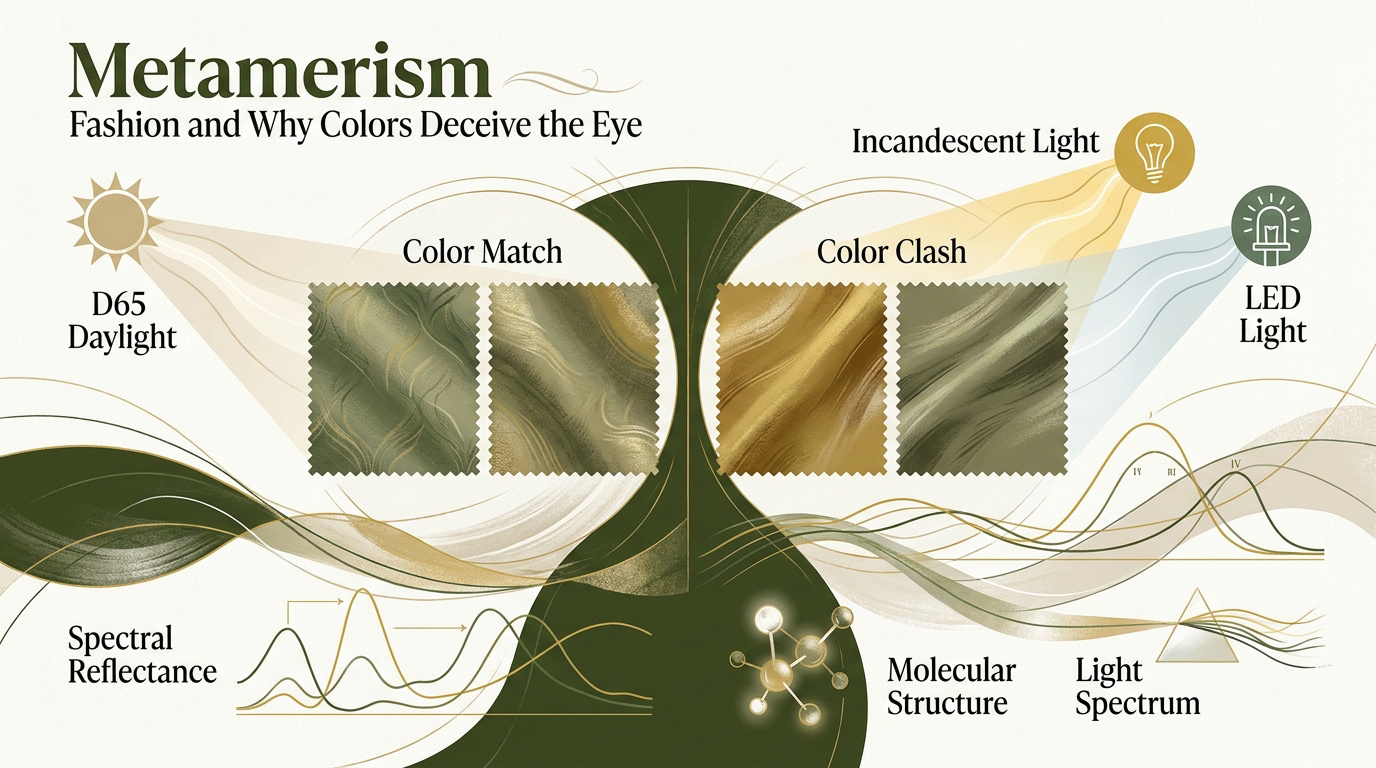
Standard Illuminants From D65 to Incandescent Lamps
D65 natural daylight differs significantly from domestic tungsten light. Their energy distribution across the spectrum is not the same. Standard illuminants provide a necessary baseline for professional color measurement.
The human eye responds to varying light energy through three types of cones. Different light sources trigger distinct neural signals for the same fabric. This explains why your outfit changes color.
Incandescent lamps offer warmth, while daylight provides a cooler blue tone. Blue wavelengths are scarce in tungsten sources, forcing the brain to reinterpret the color. This spectral power distribution shift causes the visual deception.
Lighting consistency is impossible in retail. Different bulbs produce different visual results.
3 Ways Retail Lighting Alters Fabric Perception
While the physics of light sets the stage, the specific hardware used in modern stores creates unique traps for designers.
LED Versus Fluorescent Spectral Spikes
Modern LED arrays differ from narrow-band triphosphor lamps. They possess distinct spectral spikes that older tubes lack. These spikes aggressively highlight specific color pigments, altering how we perceive the garment.
Vulnerable palettes include taupe, olive, and mauve. These specific hues shift most noticeably under cool white fluorescent bulbs, often found in shops.
Retail lighting choices prioritize low costs over color accuracy. This financial decision creates a frustrating disconnect for the everyday consumer.
Distinguishing Metamerism From Color Inconstancy
Color inconstancy occurs when a single material changes hue, often called “flaring.” A navy fabric might look purple under shop lights without any comparison.
Metamerism strictly requires a pair of samples. It is a physical property of a match between two materials, not a single item.
Inconstancy affects individual garments alone. However, metamerism ruins coordinated sets or suits made from different production batches.
Observer and Geometric Metamerism Variables
Human vision varies based on biological factors. Age-related yellowing of the lens changes perception. Professionals call this phenomenon observer metamerism during color evaluations.
Viewing angles and textures change how light scatters. A velvet fabric reflects light differently than a standard flat weave would.
Geometric metamerism depends entirely on the physical structure of the fiber. Texture can either hide or amplify these color shifts. Metamerism in Fashion: Why Two Fabrics Match in the Shop but Not Outside remains a complex challenge for designers.
How Do Manufacturing Processes Trigger Color Shifts?
Beyond the light source itself, the way we build and treat fabrics introduces new layers of spectral instability.
Fiber Composition and Dye Chemistry Choices
Evaluate the risk of matching polyester to cotton. These fibers require different pigment classes and dye processes. Achieving a stable match across both is notoriously difficult.
Suggest dye recipes that prioritize spectral stability. Using fewer dyes in a mix often reduces the risk of metameric failure.
Choose chemistries that share similar reflectance peaks. This ensures consistency across diverse environments.
Impact of Finishing Treatments and UV Exposure
Assess how industrial washing and coatings alter surface reflectance. Chemical softeners can change how light interacts with the fiber. This often shifts the perceived hue unexpectedly.
Detail the role of optical brighteners in white fabrics. These chemicals absorb UV light and re-emit it as blue light.
UV exposure during wear also degrades pigments. This causes permanent changes in color stability.
Mathematical Quantification Using Delta E and Indices
Explain the Metamerism Index (MI) used to predict shifts. It calculates the difference between two samples under various illuminants. A high index indicates a high risk.
Define Delta E tolerances for commercial production. Most brands accept a Delta E below 1.0 for high-quality garments.
Numerical data removes human error. It provides a clear standard for factory rejections.
Professional Protocols for Reliable Color Matching
To combat these invisible shifts, the industry relies on rigorous testing and clear communication lines between the studio and the mill.
Standardized Testing With Light Booths and Spectrophotometers
Visual assessment in light booths allows designers to manually observe color shifts. Meanwhile, spectrophotometers provide the objective spectral data required for precision. These tools work together to eliminate human error.
Multi-illuminant testing is vital for success. Always check samples under D65, TL84, and Horizon light sources. This process covers all common retail environments where customers view products.
Digital tools maintain consistency. They support global supply chains.
Communication Best Practices for Designers and Mills
Establish clear color standards within your tech packs. Explicitly specify the primary illuminant for all sample approvals. This step prevents confusion during the lab dip phase at the mill.
Use a sourcing checklist to guide designers. Always identify potential metameric risks before starting mass production. Early detection saves significant costs and time later.
Clear communication reduces rejections. It aligns technical teams.
Low-Tech Field Tests for Immediate Color Verification
Simple methods utilizing natural north sky light remain highly effective. This free source provides consistent daylight for quick checks. It helps identify major mismatches without expensive lab gear.
Advise teams to use grey scales when evaluating contrast. This determines if a color shift is commercially acceptable for the brand. It provides a standardized baseline for judgment.
Field tests offer quick answers. They aid quality control.
Mastering spectral reflectance and molecular dye interactions ensures your designs remain consistent from the showroom to the street. By implementing multi-illuminant testing under D65 and retail standards, you prevent metameric failure and secure brand integrity. Secure your professional reputation now by adopting these rigorous color-matching protocols for flawless results.
FAQ
Why do two garments match perfectly in the store but look different at home?
This phenomenon is known as metamerism. It occurs when two fabrics have different chemical dye structures that reflect light in a way that appears identical under specific retail lighting, such as TL84 or LED arrays. However, because their spectral reflectance curves are not identical, the match fails when the light source changes to natural daylight or warm home incandescent bulbs.
Essentially, the visual illusion is created because the light energy in the shop aligns with the points where the fabrics’ reflectance curves intersect. Once you move to a different spectral power distribution, such as a tungsten lamp, the physical differences in the dye molecules become visible to the human eye.
What are the primary standard illuminants used to test fashion textiles?
The textile industry relies on several standard illuminants to ensure color consistency. The primary reference is D65, which simulates average midday daylight. This is the global baseline for most fashion programs to ensure garments look correct in natural environments.
Other critical sources include TL84, a triphosphor fluorescent common in European retail, and CWF, a cool white fluorescent often used in North American offices. For home simulation, Illuminant A mimics traditional tungsten lighting, which is vital for evening wear and domestic settings.
How do modern LED and fluorescent lights affect how we see clothing colors?
Unlike natural daylight, LED and fluorescent sources often have spectral spikes, meaning they emit concentrated energy at specific wavelengths rather than a continuous spectrum. These spikes can aggressively highlight certain pigments, particularly in sensitive palettes like taupe, olive, or mauve, causing them to shift hue unexpectedly.
Retailers often choose lighting based on energy efficiency rather than color accuracy. This creates a disconnect for consumers, as the spectral power distribution of shop lights can make a navy suit appear purple or a white shirt look unnaturally blue due to the activation of optical brighteners.
What is the difference between metamerism and color inconstancy?
While often confused, metamerism strictly refers to a pair of samples, such as a jacket and trousers, that match under one light but clash under another. It is a physical property of a match between two different materials or dye batches.
In contrast, color inconstancy (or “flaring”) refers to a single material changing its perceived hue when moved between light sources. For example, a single burgundy dress might look brown under office lights without being compared to anything else. Metamerism is the primary concern for coordinated sets and suits made from different fiber compositions.
How do manufacturers measure and prevent these color shifts?
Professionals use a Metamerism Index (MI) to quantify the risk of a color shift. By using spectrophotometers, they calculate the Delta E (color difference) between samples under multiple illuminants. A Delta E below 1.0 is generally the target for high-quality commercial production to ensure the match remains stable.
To prevent failures, designers include specific illuminant requirements in tech packs and use light booths to manually verify lab dips. Choosing dye recipes with fewer pigments and similar reflectance peaks across different fibers, like polyester and cotton blends, helps maintain spectral stability throughout the supply chain.
Can I perform a simple test to check for color mismatches without lab equipment?
Yes, a reliable low-tech method is to use north sky light, which provides a consistent and natural source of daylight. By observing coordinated pieces next to a window facing north, you can often identify major metameric mismatches that are hidden by artificial shop lights.
Designers also use grey scales to evaluate if a shift is commercially acceptable. These field tests provide immediate verification on the production floor or in-store, helping to catch perceived hue discrepancies before a garment reaches the customer.
FAQ
Why do two garments match perfectly in the store but look different at home?
This phenomenon is known as metamerism. It occurs when two fabrics have different chemical dye structures that reflect light in a way that appears identical under specific retail lighting, such as TL84 or LED arrays. However, because their spectral reflectance curves are not identical, the match fails when the light source changes to natural daylight or warm home incandescent bulbs.
Essentially, the visual illusion is created because the light energy in the shop aligns with the points where the fabrics’ reflectance curves intersect. Once you move to a different spectral power distribution, such as a tungsten lamp, the physical differences in the dye molecules become visible to the human eye.
What are the primary standard illuminants used to test fashion textiles?
The textile industry relies on several standard illuminants to ensure color consistency. The primary reference is D65, which simulates average midday daylight at 6500K. This is the global baseline for most fashion programs to ensure garments look correct in natural environments.
Other critical sources include TL84 (4000K), a triphosphor fluorescent common in European retail, and CWF (4150K), a cool white fluorescent often used in North American offices. For home simulation, Illuminant A (2856K) mimics traditional tungsten lighting, which is vital for evening wear and domestic settings.
How do modern LED and fluorescent lights affect how we see clothing colors?
Unlike natural daylight, LED and fluorescent sources often have spectral spikes, meaning they emit concentrated energy at specific wavelengths rather than a continuous spectrum. These spikes can aggressively highlight certain pigments, particularly in sensitive palettes like taupe, olive, or mauve, causing them to shift hue unexpectedly.
Retailers often choose lighting based on energy efficiency rather than color accuracy. This creates a disconnect for consumers, as the spectral power distribution of shop lights can make a navy suit appear purple or a white shirt look unnaturally blue due to the activation of optical brighteners.
What is the difference between metamerism and color inconstancy?
While often confused, metamerism strictly refers to a pair of samples, such as a jacket and trousers, that match under one light but clash under another. It is a physical property of a match between two different materials or dye batches.
In contrast, color inconstancy (or “flaring”) refers to a single material changing its perceived hue when moved between light sources. For example, a single burgundy dress might look brown under office lights without being compared to anything else. Metamerism is the primary concern for coordinated sets and suits made from different fiber compositions.
How do manufacturers measure and prevent these color shifts?
Professionals use a Metamerism Index (MI) to quantify the risk of a color shift. By using spectrophotometers, they calculate the Delta E (color difference) between samples under multiple illuminants. A Delta E below 1.0 is generally the target for high-quality commercial production to ensure the match remains stable.
To prevent failures, designers include specific illuminant requirements in tech packs and use light booths to manually verify lab dips. Choosing dye recipes with fewer pigments and similar reflectance peaks across different fibers, like polyester and cotton blends, helps maintain spectral stability throughout the supply chain.
Can I perform a simple test to check for color mismatches without lab equipment?
Yes, a reliable low-tech method is to use north sky light, which provides a consistent and natural source of daylight. By observing coordinated pieces next to a window facing north, you can often identify major metameric mismatches that are hidden by artificial shop lights.
Designers also use grey scales to evaluate if a shift is commercially acceptable. These field tests provide immediate verification on the production floor or in-store, helping to catch perceived hue discrepancies before a garment reaches the customer.