
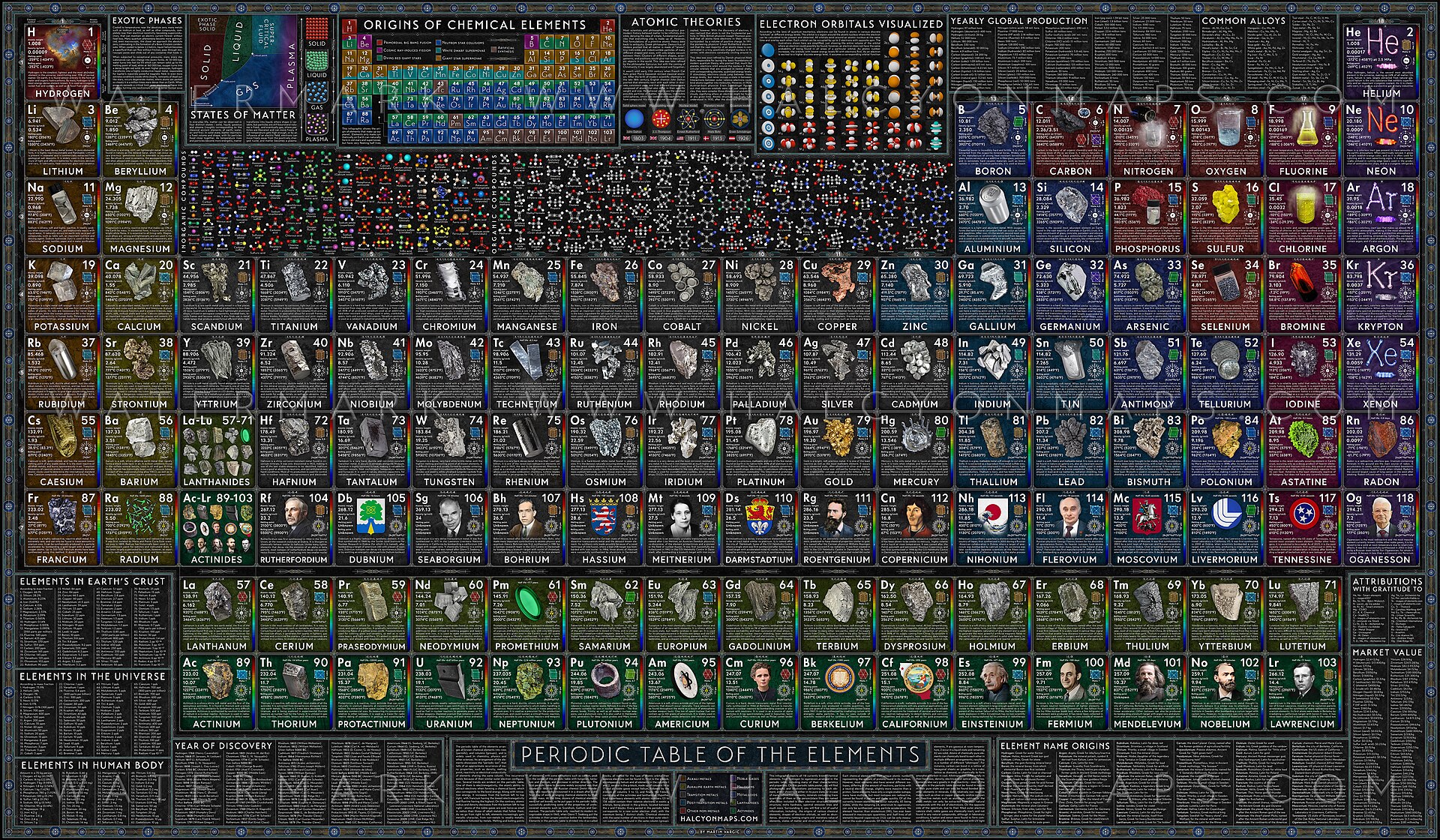
- Colors differ between charts, so always read the key first.
- Find a group by its name and place in the table, not by color alone.
- Elements in one group share properties because they have the same number of outer electrons, the ones that drive chemical reactions.
- Metals sit left of the stair-step line, nonmetals to its right, and metalloids on the line.
Contents
- The Periodic Table Color-Coded: Which Hue Marks Which Element Group
- Naming the families: from alkali metals to noble gases
- Why do elements in one column behave alike?
- Where metals, metalloids and nonmetals sit on the table
- Colors are a chart-maker’s key, not a universal standard
- Frequently asked questions
Periodic tables in classrooms, textbooks and posters use a rainbow of colors, and no two charts use exactly the same ones.
So a color alone won’t tell you which family an element belongs to. This article explains what each hue marks, how each group is defined, and why the elements in one group behave alike.
The Periodic Table Color-Coded: Which Hue Marks Which Element Group
Start with the left edge. Red marks the alkali metals in Group 1, and pink marks the alkaline earth metals in Group 2, right next to it.
Orange covers the transition metals, Groups 3 to 12, in the middle block. On the right edge, dark blue marks the halogens in Group 17, and purple marks the noble gases in Group 18.
Three colors mark special categories rather than whole groups. Green marks the metalloids, such as boron and silicon. Yellow marks the two bottom rows, the lanthanoids and actinoids.
Light blue marks hydrogen, carbon, nitrogen, oxygen and a few others. So don’t memorize a color: check the legend, because another chart may use different colors for the same categories.
Naming the families: from alkali metals to noble gases
Alkali metals are lithium, sodium, potassium, rubidium, caesium and francium. Alkaline earth metals are beryllium, magnesium, calcium, strontium, barium and radium.
Halogens are fluorine, chlorine, bromine, iodine and astatine. Noble gases are helium, neon, argon, krypton, xenon and radon. Transition metals fill Groups 3 to 12.
Read the group numbers across the top. IUPAC, the chemistry naming body, numbers the columns from 1 to 18. Some tables use 32 columns, so read the number above each column, not just its color.
The lanthanoids run from lanthanum (La) to lutetium (Lu), and the actinoids from actinium (Ac) to lawrencium (Lr). Look at these names, and check the legend, to tell them apart from the other families.
Why do elements in one column behave alike?
What decides how an atom reacts? The answer is the valence electrons: the ones in the outermost shell. They drive most chemical behaviour, including the bonds an atom forms.
Group 1 atoms have one valence electron, and Group 2 atoms have two. For Groups 13 to 18, the count goes from three to eight. This pattern repeats down each group, so its members usually react alike.
Helium is the exception in group 18. It has two valence electrons, not eight, because its only shell is full with two. That full shell makes it stable, like the other noble gases.
Lithium and beryllium share a period, so they add electrons to the same main energy level. That doesn’t make them react alike. To compare how they behave, look down the column: lithium and sodium share a group.
Where metals, metalloids and nonmetals sit on the table
Start with the stair-step line. Metals sit to its left. They are shiny, can be bent without breaking, and conduct heat and electricity well.
Nonmetals sit to its right. They are dull and conduct poorly.
Elements on the line are metalloids, like silicon and germanium. They have traits of both groups, and many are semiconductors, which conduct only partly. Check the traits, not just the position.
A block name only tells you where the outer electron is added. It does not tell you whether an element is a metal. Aluminium, in Group 13, and tin, in Group 14, are both metals in the p block.
Hydrogen sits at the top of Group 1, but it is a nonmetal with traits unlike the alkali metals. So it is not an alkali metal.
Colors are a chart-maker’s key, not a universal standard
The same family can change color from one chart to the next. On one worksheet, alkali metals are red. On another, they are green, so the color alone tells you nothing.
Find each group by its name and its place in the table, then read the key. A chart that colors metals, nonmetals and metalloids may use yellow, green and purple, while another uses blue, red and green.
Always read the key before you trust a color. IUPAC sets group numbers, but not the colors. One classroom key paints halogens yellow and noble gases white.
So check the names and the stair-step line too. Patterns or labels tell families apart even when the colors differ, and the stair-step line still separates metals from nonmetals.
Always read the key before you trust a color. Find each group by its name and place in the table. Elements in one group share properties because they have the same number of outer electrons.
Next, open your chart, read its key, and check the group numbers across the top.
Frequently asked questions
Why is hydrogen not classed as an alkali metal?
Hydrogen is a nonmetal, so it isn’t an alkali metal, even though it sits in Group 1 with them. Its traits are different. Lithium and sodium are shiny metals, while hydrogen is a gas.
Why does helium sit in Group 18 with two valence electrons?
Helium sits in Group 18 because its first shell holds two electrons, and that shell is full at two.
A full outer shell is stable, so helium behaves like the other noble gases, even though it has fewer valence electrons than they do.
Are lanthanoids and actinoids the same as rare-earth metals?
No. Lanthanoids and actinoids are separate series, so they are not the same as rare earth metals. That term includes scandium, yttrium and the lanthanoids. Check which elements a chart counts under it.
What is the difference between a period and a group?
A group is a vertical column of the table, and a period is a horizontal row.
Lithium and sodium share a group, so they sit in the same column. Lithium and beryllium share a period, so they sit in the same row.
Related reading
Photo: WORLD OF THE ELEMENTS, by Martin Vargic / Halcyonmaps, CC BY-SA 3.0 (Wikimedia Commons)