
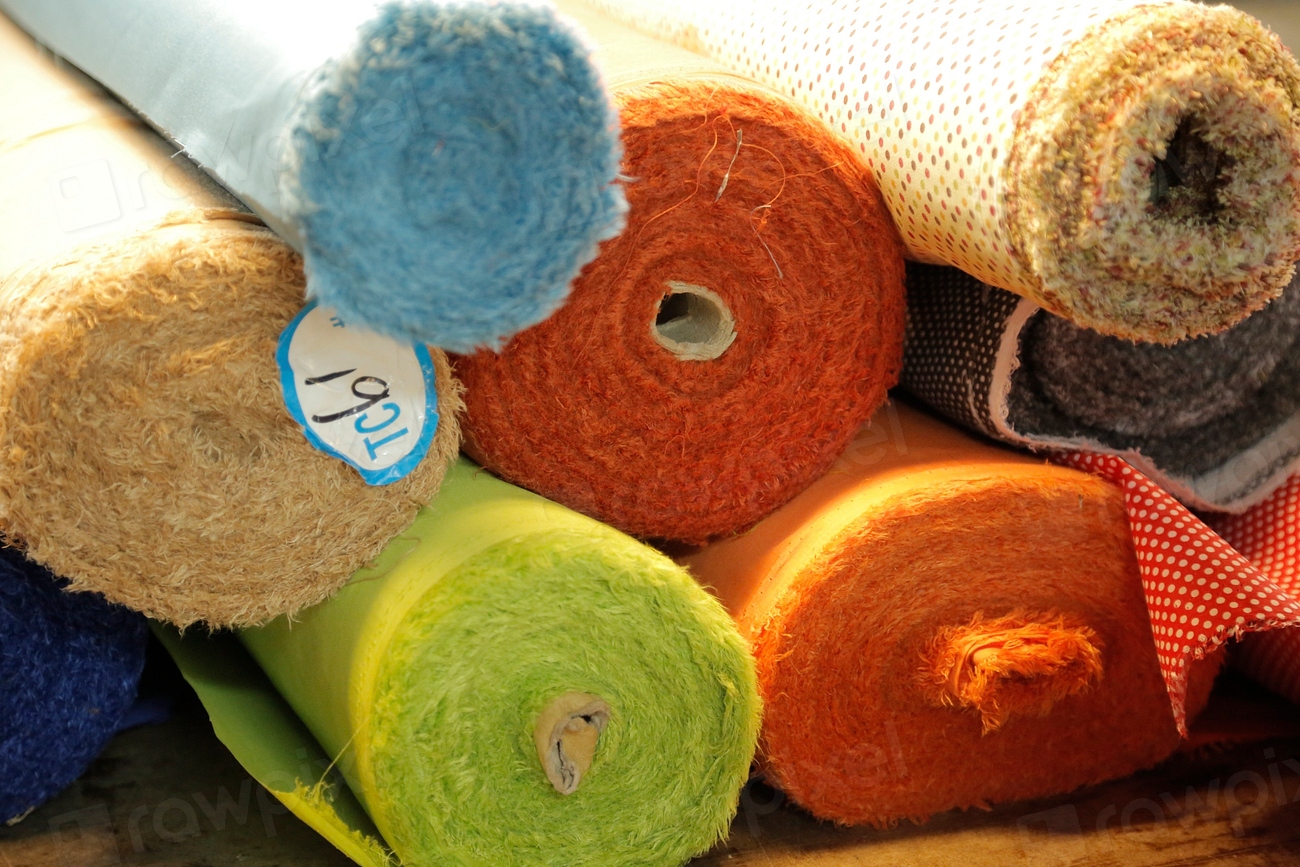
Cloth is the hardest place to put colour
Printing colour onto paper is a controlled problem: a flat, uniform substrate, a known ink set, a finished object that will mostly sit indoors. Textiles offer none of that comfort. A dyer is asked to put colour into a three-dimensional tangle of fibres, each with its own chemistry, then hand the result to someone who will wash it, wear it in sunlight, sweat into it and expect the colour to survive for years. Then they will want the same colour again next season, from a different mill, on a different fibre, matching a shell fabric dyed elsewhere.
This article works through how dyeing actually functions, what colourfastness means and how it is measured, why matching across fabrics is so difficult, and how seasonal colour palettes are set eighteen months before anyone buys anything.
Dyes, pigments and the difference that matters
A pigment is an insoluble particle that sits on a surface, held there by a binder. A dye is a molecule that dissolves, penetrates the fibre and bonds with it. That distinction governs almost everything about textile colour.
Pigment coloration — used in pigment printing and some garment finishes — is cheap, works on any fibre, and gives excellent light stability, because the colourant is a robust particle. Its weakness is that it sits on top: it stiffens the hand of the fabric and it abrades away, which is exactly why pigment-printed tee shirts crack at the print and why some denim finishes fade attractively at the seams. That fading is a defect being sold as a feature, which it genuinely can be.
Dyes go inside the fibre. They give a soft hand, deep penetration and far better rub resistance, but each dye class only bonds with certain fibres. This is the central constraint of the industry: you cannot pick a colour and apply it to anything.
The main dye classes
- Reactive dyes. The standard for cotton and other cellulosics. They form a genuine covalent bond with the fibre, which gives excellent wash fastness and brilliant shades. The cost is process-heavy: large quantities of salt and alkali, substantial water use, and a hydrolysed fraction of dye that never bonds and must be washed out and treated.
- Disperse dyes. The only practical route for polyester, which is hydrophobic and has no sites for conventional dyes. Applied as a fine dispersion at around 130 degrees Celsius under pressure, the dye diffuses into the softened polymer. Good fastness, but prone to sublimation — migrating out again under heat, which is why a dark polyester lining can stain a pale outer during pressing.
- Acid dyes. For wool, silk and nylon, all of which carry amino groups that attract the dye in an acidic bath. Superb brightness and shade range. Wool dyeing is a balancing act because the temperatures needed for good penetration also damage the fibre.
- Vat dyes. Indigo is the famous member. Insoluble in normal form, they are chemically reduced to a soluble state, absorbed, then oxidised back to insolubility inside the fibre. Outstanding fastness. Indigo is a partial exception because it sits mainly in the outer layers of the yarn, which is what produces denim’s characteristic wear pattern.
- Sulphur dyes. Cheap, deep, dull shades — blacks, browns, navies — on cotton. Economically important, environmentally awkward because of the sulphide chemistry involved.
When in the process the colour goes on
The same dye can be applied at four different stages, and the choice affects cost, flexibility, evenness and waste more than most people outside a mill appreciate.
- Fibre or stock dyeing. Loose fibre is dyed before spinning. Penetration is excellent and the resulting yarn has a depth and subtlety that later stages cannot match, because slightly different coloured fibres blend within the yarn. It is also the least flexible: the colour is committed before anyone knows what will sell.
- Yarn dyeing. Dyed in hanks or on packages, then woven or knitted. Essential for stripes, checks and any patterned construction where colour must be built into the structure. Commitment is still early.
- Piece dyeing. Greige fabric is woven first and dyed later. This is the volume workhorse for solid colours, because it lets a mill hold undyed stock and colour it against real orders. The whole cloth takes one shade, so blends of different fibres either need a dye that works on both or accept a two-tone effect.
- Garment dyeing. The finished garment is dyed. Maximum responsiveness — a retailer can chase a colour that is selling — but it demands that every component, including thread, labels and trims, either takes the dye acceptably or is deliberately chosen to resist it. Shade consistency across a batch of assembled garments is harder to control.
- Dope dyeing. For synthetics only: pigment is added to the polymer before extrusion, so the fibre is coloured from birth. Outstanding fastness and almost no dyehouse water, but the colour is fixed at the earliest possible moment in the chain.
The general rule is a trade-off between quality of penetration and lateness of commitment. The earlier the colour goes on, the better it usually looks and the more inventory risk it creates.
Colourfastness: the number that decides returns
Fastness is the resistance of a colour to a specific stress. It is not one property. A dye can be excellent to washing and poor to light, or the reverse, and a specification will name each test separately.
Most fastness results are reported on a grey scale from 1 to 5, where 5 means no perceptible change and 1 means severe change. Light fastness uses a separate blue wool scale running 1 to 8, where 8 is exceptionally durable, because light exposure spans a far wider range of severity.
- Wash fastness. Tested by agitating the specimen with standard detergent at a defined temperature alongside a multifibre strip. Two things are graded: how much the specimen changed, and how much colour transferred to each fibre on the strip. The second is often what causes commercial trouble.
- Rubbing fastness (crocking). A standard white cloth is rubbed against the specimen dry and wet under controlled pressure. Wet crocking is far more demanding, and deep indigos and blacks routinely struggle. Anyone who has seen a new dark denim tint a pale sofa has seen crocking failure.
- Light fastness. Accelerated exposure in a xenon-arc cabinet with controlled irradiance, temperature and humidity. Curtains, upholstery and outdoor gear need high ratings; a lined winter coat does not.
- Perspiration fastness. Tested with synthetic acid and alkaline sweat solutions under weight and heat. Relevant to anything worn against skin, and a common source of underarm discoloration complaints.
- Water and chlorine fastness. Essential for swimwear, where chlorine bleaching and elastane degradation combine to shorten life dramatically.
Why fastness and brightness pull against each other
Broadly, the molecular features that make a dye brilliant — extended conjugation, a structure that absorbs a narrow band cleanly — also make it vulnerable to photochemical attack. The most durable colourants tend to be larger, more inert and duller. This is a real trade-off, not a failure of effort, and it is why a vivid fluorescent pink will never have the light fastness of an iron-oxide-adjacent brown.
Matching across fibres, and the metamerism trap
A garment is rarely one material. A jacket might combine a wool shell, a polyester lining, a nylon zip tape, a cotton label and elastane-blended cuffs. Each needs a different dye class to reach the same target shade. Because the dye molecules differ, their spectral reflectance curves differ — and two samples with different curves that match under one light can visibly separate under another.
This is why serious apparel specifications name the illuminants under which a match must hold, typically a daylight simulator plus a store lighting condition plus incandescent, and require the match to survive all of them. A supplier who matches only under the lightbox daylight lamp will ship a collection that falls apart under retail lighting.
The practical defences are unglamorous but effective.
- Specify the standard physically and numerically. A dyed physical standard plus tolerance limits in a device-independent colour space, not a printed swatch or a screen image.
- Approve under multiple illuminants. Any pair that separates unacceptably when the lamp changes should be rejected at lab-dip stage, not at final production.
- Set tolerances by end use. A trim shade that will sit two centimetres from the shell needs a tighter tolerance than a lining nobody will see beside it.
- Control the batch. Shade variation within a dye lot, and between the ends and middle of a continuous run, is a permanent operational problem. Cutting rooms manage it by shade-sorting rolls so that one garment never mixes lots.
The failures a mill sees every week
Textile colour goes wrong in a small number of recognisable ways, and knowing them makes specifications sharper.
- Listing (side-to-centre variation). A continuous range dyes the selvedges differently from the middle, so a garment cut across the width shows a gradient. Caught by measuring across the width, not just at one point.
- Ending. Shade drifts from the start of a roll to the end as the bath depletes. This is why cutting rooms shade-sort and why a sleeve can differ from a body.
- Barre. Horizontal banding in knits, caused by yarn from different packages or spinning positions taking dye slightly differently. Frequently invisible in greige and glaringly obvious after dyeing.
- Skitteriness. A speckled, unlevel appearance from uneven dye uptake between individual fibres, common in wool and in blends.
- Migration and staining. Dye moving out of one component into another during finishing, pressing, storage or the first wash. Dark navies and reds against white are the classic risk pairing.
Most of these are process control problems rather than colourant problems, which is why an experienced buyer specifies the test methods and the acceptance limits rather than simply naming a shade and hoping.
How seasonal palettes are actually decided
The romantic story is that a colour forecaster senses the mood of the age. The real process is a mixture of long-lead industrial necessity, genuine cultural observation and self-fulfilling coordination.
The timeline drives everything. Yarn and fabric mills need commitments long before garments are designed, so colour direction is set roughly eighteen to twenty-four months ahead of retail. Forecasting bodies and trade fairs publish palettes; fibre producers, mills, brands and retailers all consult broadly the same sources. The result partly coordinates the supply chain and partly manufactures the trend it predicts — if every mill dyes the same dusty terracotta, that is what will be available to buy.
What genuinely shapes a palette
- Carryover economics. Core colours — navy, black, white, grey, a mid denim blue — are the bulk of volume in most ranges. Seasonal colour is a comparatively thin, high-risk layer on top.
- Fibre and process constraints. Some shades are simply expensive or unreliable on the season’s dominant fabrics. A palette that cannot be hit on the relevant substrates does not survive contact with sampling.
- Light and season. Autumn and winter ranges skew towards lower-lightness, lower-chroma colours that behave under weak northern daylight and indoor lighting; spring and summer ranges carry more chroma and higher lightness.
- Cultural signal. Film, sport, politics and the platforms people scroll do move colour, but usually with a lag and usually amplified by the forecasting apparatus rather than discovered by it.
- Reaction to the last cycle. Palettes oscillate. Several seasons of saturated brights reliably produce a swing to muted neutrals, and vice versa, because differentiation is the point.
For a working designer, the useful posture is to treat forecast palettes as a supply-chain fact rather than a prophecy. Knowing which colours will be cheap, available and consistent next season is worth more than knowing which one a trade body has named colour of the year. And whatever the palette, the questions that determine whether the garment succeeds are the same ones dyers have been answering for centuries: will it bond, will it hold, and will it still match its own lining after twenty washes.