
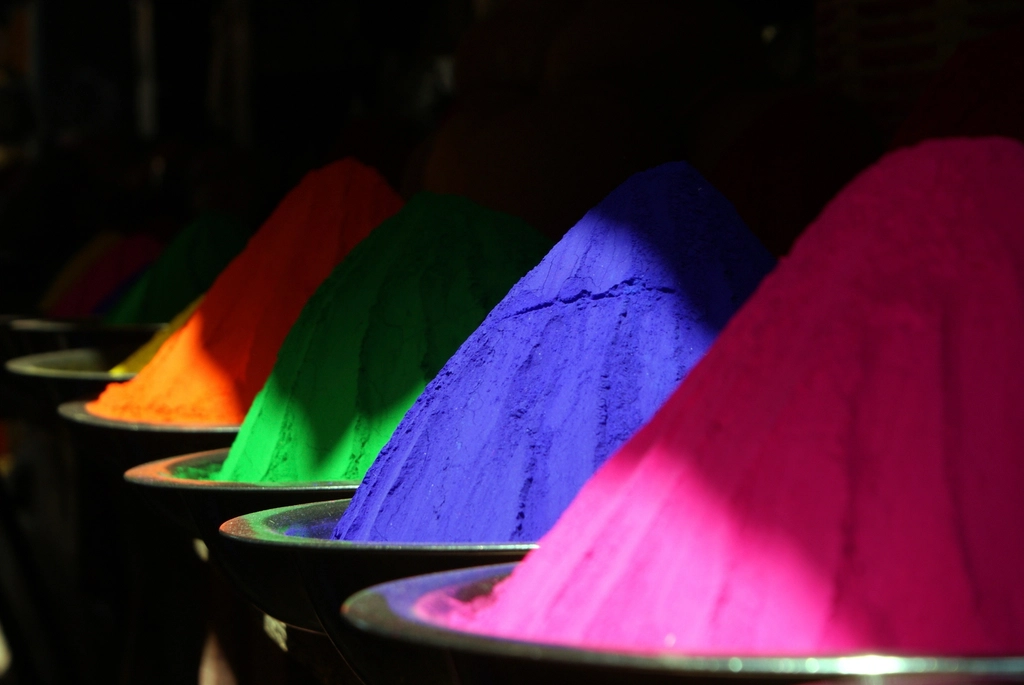
Colour as chemistry
Strip away perception and measurement and a physical question remains: why is a particular substance the colour it is? The answer lies in the electronic structure of molecules and crystals, and it is worth understanding because it governs everything a colourist cares about downstream. Why one red fades in sunlight while another survives decades. Why a pigment that is brilliant in oil turns muddy in water based binder. Why some shades were, until modern chemistry, effectively unobtainable at any price.
The mechanism of absorption
Electrons in a molecule occupy discrete energy levels. When light strikes, a photon can be absorbed only if its energy exactly matches the gap between an occupied level and an empty one. Photon energy is inversely proportional to wavelength, so the size of that gap determines which part of the spectrum is removed. What is not absorbed is reflected or transmitted, and that remainder is the colour we see. A material absorbing in the blue region around 450 nanometres appears yellow to orange, because it returns everything else.
Most organic colourants achieve suitable gaps through conjugation: alternating single and double bonds along a molecular backbone, which lets electrons spread over an extended region rather than staying localised between two atoms. The longer the conjugated chain, the smaller the energy gap and the longer the wavelength absorbed. This is why extending conjugation shifts a compound from colourless to yellow to red and onward towards blue, a progression known as a bathochromic shift.
Chromophores and auxochromes
Nineteenth century chemists gave names to the parts responsible. The chromophore is the group that does the absorbing, most commonly the azo group, two nitrogen atoms joined by a double bond, which underpins the majority of synthetic dyes in commercial use. Anthraquinone, phthalocyanine and triarylmethane systems account for much of the remainder.
The auxochrome is a substituent that modifies the chromophore’s behaviour without being coloured itself. Hydroxyl, amino and sulphonate groups donate or withdraw electron density, shifting the absorption band and altering intensity. They also do the practical work: sulphonate groups confer water solubility, and amino groups provide sites for bonding to fibre. A dye is therefore an engineered object with a colour producing core and functional groups selected for the substrate and the process.
Inorganic colour
Inorganic pigments generally work by different routes. Transition metal compounds absorb through d orbital transitions: in a crystal field the metal ion’s d orbitals split into levels separated by energies that happen to fall in the visible range. Chromium oxide green and cobalt blue are examples, and the precise hue depends on the surrounding ions as much as on the metal itself.
Charge transfer is a second route, in which an electron moves between two different ions or between a ligand and a metal. These transitions are strongly allowed and produce intense colours from small quantities. The blue of natural ultramarine, from lapis lazuli, comes from trapped polysulphide ions in an aluminosilicate cage, and its extraordinary saturation for so little colourant reflects that mechanism.
In semiconductor pigments the absorption is set by the band gap. Cadmium sulphide has a gap that absorbs violet and blue, leaving yellow. Substituting selenium for some of the sulphur narrows the gap progressively, sweeping the pigment through orange to deep red. It is one of the cleanest demonstrations of composition tuning colour available.
Pigments and dyes are not the same thing
The terms are often used loosely, and the distinction is fundamental. A dye is soluble in its application medium. It dissolves, penetrates the substrate, and associates with it at molecular scale. A pigment is insoluble. It exists as discrete solid particles dispersed in a binder and sits on or within the material as a suspension of tiny crystals.
Everything else follows from that. A dye becomes part of the fibre and does not alter its handle; a pigment adds a physical layer, which is why pigment printed fabric feels stiffer than reactive dyed fabric. Dyed colour is transparent, so it builds by depth of shade; pigmented colour is usually opaque, because the particles scatter as well as absorb.
Where particle size takes over
For a pigment, the crystal is only half the story. Particle size and distribution govern scattering, and scattering governs opacity, tinting strength and even hue. Maximum scattering occurs when particles are roughly half the wavelength of the light being scattered, which is why titanium dioxide for opacity is ground to around 0.2 to 0.3 micrometres. Grind finer and hiding power falls; leave it coarser and it falls again.
The same pigment chemistry can also crystallise in different forms. Copper phthalocyanine blue exists in alpha and beta polymorphs: same molecule, different crystal packing, visibly different hue, with the alpha form redder and less stable. Dispersion quality matters as much. A poorly dispersed pigment with agglomerated particles delivers weaker, duller colour than the same material properly milled, and the difference between a good and a bad dispersion of one pigment can exceed the difference between two pigment grades.
Dye classes and the fibres they serve
Dyeing is a bonding problem, and each fibre demands a different solution.
- Reactive dyes. Form covalent bonds with hydroxyl groups in cellulose. The workhorse for cotton and viscose, giving bright shades and excellent wash fastness. The cost is efficiency: a proportion of the dye hydrolyses instead of bonding, so unfixed dye must be washed out, which is where much of the water use in cotton dyeing goes.
- Disperse dyes. Small, essentially insoluble molecules applied as a fine aqueous dispersion, used for polyester and other hydrophobic synthetics. At elevated temperature the fibre swells and the dye diffuses into it, held by physical forces. Their small size makes them prone to sublimation, which is exploited deliberately in heat transfer printing.
- Acid dyes. Anionic dyes applied in acidic conditions to wool, silk and nylon, binding ionically to protonated amino groups. They give a wide, brilliant gamut on protein fibres.
- Vat dyes. Insoluble pigments reduced to a soluble form, absorbed by the fibre, then reoxidised in place so they become trapped as insoluble particles. Indigo works this way, and its poor penetration into the yarn core is precisely why denim fades as it does.
- Direct dyes. Long, flat molecules held on cellulose by van der Waals forces and hydrogen bonding. Simple and cheap to apply, with modest wet fastness unless aftertreated.
Fastness: colour that stays put
A colour that will not survive the product’s life is a defect however well it matches on day one. Fastness is assessed separately for each hazard and reported on standardised grey scales, and the failure modes have different causes.
- Light fastness. Ultraviolet radiation supplies enough energy to break bonds within the chromophore. Once the conjugated system is disrupted, the absorption band shifts or disappears and the colour fades. Assessed on a 1 to 8 scale against blue wool references.
- Wash fastness. Depends on how firmly the colourant is held. Covalently bonded reactive dyes score well; direct dyes, held only by weak physical forces, do not.
- Rub fastness. Also called crocking, this is colourant transferring by mechanical abrasion. It usually indicates surface deposited dye that was never properly fixed or washed off.
- Perspiration and saliva fastness. Governed by pH sensitivity and by the mobility of the dye. Critical for garments in contact with skin and for anything intended for young children.
There is a persistent trade off between brilliance and durability. The molecular features that make a dye vivid, extended conjugation and high electron mobility, are the same features that make it vulnerable to photochemical attack. Formulators live inside this compromise, and the more saturated the target shade, the less room they have.
Constraint and invention
Palettes have always been shaped by what was chemically available. Tyrian purple required thousands of molluscs per gram and priced itself into imperial regalia. Ultramarine ground from lapis lazuli cost more than gold and was reserved for the most important passages of a painting. Mauveine, produced accidentally by William Perkin in 1856 while attempting to synthesise quinine, opened the synthetic dye industry and made vivid colour available to ordinary buyers within a generation.
The constraints have shifted rather than vanished. Certain azo dyes that can cleave to release restricted aromatic amines are prohibited in textiles reaching consumers. Heavy metal pigments based on cadmium and lead are restricted or eliminated in most applications, and their replacements rarely match the original brilliance exactly. Effluent treatment, water consumption and process temperature now weigh on recipe selection alongside shade and fastness. The chemistry of colour has never been a purely aesthetic discipline, and it is less so now than at any point in its history.